

Blog

Perkins V Compliance Guide: 2026 CTE Funding & IRC Strategy

Steve Waddell • February 13, 2026

As we navigate the 2025-2026 academic year, the federal expectations for Career and Technical Education (CTE) have undergone a significant maturation. It is no longer sufficient for a district to simply point to a computer lab and claim "workforce readiness." Under the current iteration of the Strengthening Career and Technical Education for the 21st Century Act (Perkins V), funding is strictly tied to measurable quality, equity of access, and—most importantly—alignment with the Comprehensive Local Needs Assessment (CLNA).


For CTE Teachers, Directors, and Superintendents, the stakes are exceptionally high. Federal auditors and state agencies are looking for more than participation numbers; they are looking for Credentials of Value. This guide explores how to strategically align your digital media, coding, and design pathways to ensure your program remains a "safe harbor" for Perkins V funding while delivering world-class outcomes for your students. We are currently entering the critical 2026-2029 State Plan cycle, meaning the decisions made this quarter will dictate your funding eligibility for the next several fiscal years.


Understanding the CLNA: The Foundation of Your Funding

The Comprehensive Local Needs Assessment is not just a paperwork hurdle; it is the diagnostic heart of your program. In 2026, the CLNA requires a "diverse body of stakeholders," including local industry leaders, to validate that what you are teaching actually reflects the modern labor market.


To maximize your local application for Perkins funds, your CLNA must identify specific gaps in student performance. If your data shows that students from underrepresented backgrounds are not completing pathways at the same rate as others, your funding must be targeted toward "program improvement" to bridge that gap. This is whereCTeLearning’s device-neutral strategy becomes a critical compliance tool. By removing hardware barriers, you are solving the equity requirement of Perkins V before a student even logs in.


The IRC Gold Standard: Your Compliance Shield

The most effective way to protect your Perkins V funding is to integrate Industry-Recognized Credentials (IRC) into the core of your curriculum. However, as the tech landscape becomes saturated with "digital badges," there is a clear distinction between an "attendance certificate" and a validated credential.


Perkins V Section 134 specifically mandates that funded programs must be of sufficient "Size, Scope, and Quality." In 2026, "Quality" is increasingly defined by third-party validation. By aligning ourHigh School CTE Curriculum with an international professional body, we move the burden of proof from the teacher to the industry. When an auditor asks how you know your Web Design program is current, you don't show them a textbook; you show them a credential path that is updated annually based on global industry standards. This ensures that the state’s investment is buying a future-proof skill set.


Deep Dive: The Job Task Analysis (JTA) Framework

One of the core requirements of the CLNA is proving labor market alignment. The technology of 2026 moves at the speed of AI, not the speed of bureaucratic updates. To remain compliant, your curriculum must be based on a Job Task Analysis (JTA)—the process where industry experts define exactly what an entry-level professional must know today.


Our pathways inWeb Design, Animation, andGame Design are built on JTAs. For example, our Web Design curriculum reflects the 2026 shift toward AI Ethics, Responsive Design, and WCAG 2.2 Accessibility. By teaching these specific, high-demand skills, your program naturally aligns with the "High-Wage, High-Demand" requirement of Perkins V Section 134(c). Furthermore, we ensure that our Job Task Analyses are mapped directly to the U.S. Department of Labor’s O*NET database, providing the precise coding required for state-level reporting. Without a JTA-backed curriculum, your program is at risk of being labeled "out of alignment" during a state monitoring visit.


The 94% Metric: Data-Driven Accountability

The ultimate proof of a program's success is its pass rate. Many districts struggle with certification exams because the curriculum is disconnected from the test. CTeLearning boasts a 94% first-attempt pass rate for secondary students. This isn't just a point of pride; it is a critical data point for your state's "Prepared for Success" metrics.


High pass rates signal to grant writers and federal agencies that your Perkins V dollars are being invested in a system that works. In 2026, where "Return on Investment" (ROI) is the buzzword in education finance, being able to demonstrate that 9 out of 10 students are leaving your program with a professional-grade IRC is the most powerful argument you can make for continued and expanded funding. It justifies the cost per student and makes the "Program Quality" indicator (5S1) easy to defend.


WIOA and the Workforce Pipeline Alignment

The 2026 "Combined State Plan" model increasingly aligns Perkins V with the Workforce Innovation and Opportunity Act (WIOA). This means high school pathways are no longer siloed; they are expected to feed directly into the local workforce, apprenticeships, or post-secondary education.


Through our partnership with Web Professionals Global, your students aren't just "taking a class." They are entering a professional ecosystem. They earn credentials recognized by the U.S. Department of Labor, facilitating a seamless transition from the classroom to a career. This alignment is essential for districts looking to secure "Innovation Grants" or "Governor's Workforce" funds that sit outside the standard Perkins formula. When your program is WIOA-aligned, you open the door to Department of Labor funding that can supplement your education budget and provide for paid student internships.


The Role of Professional Development in Compliance

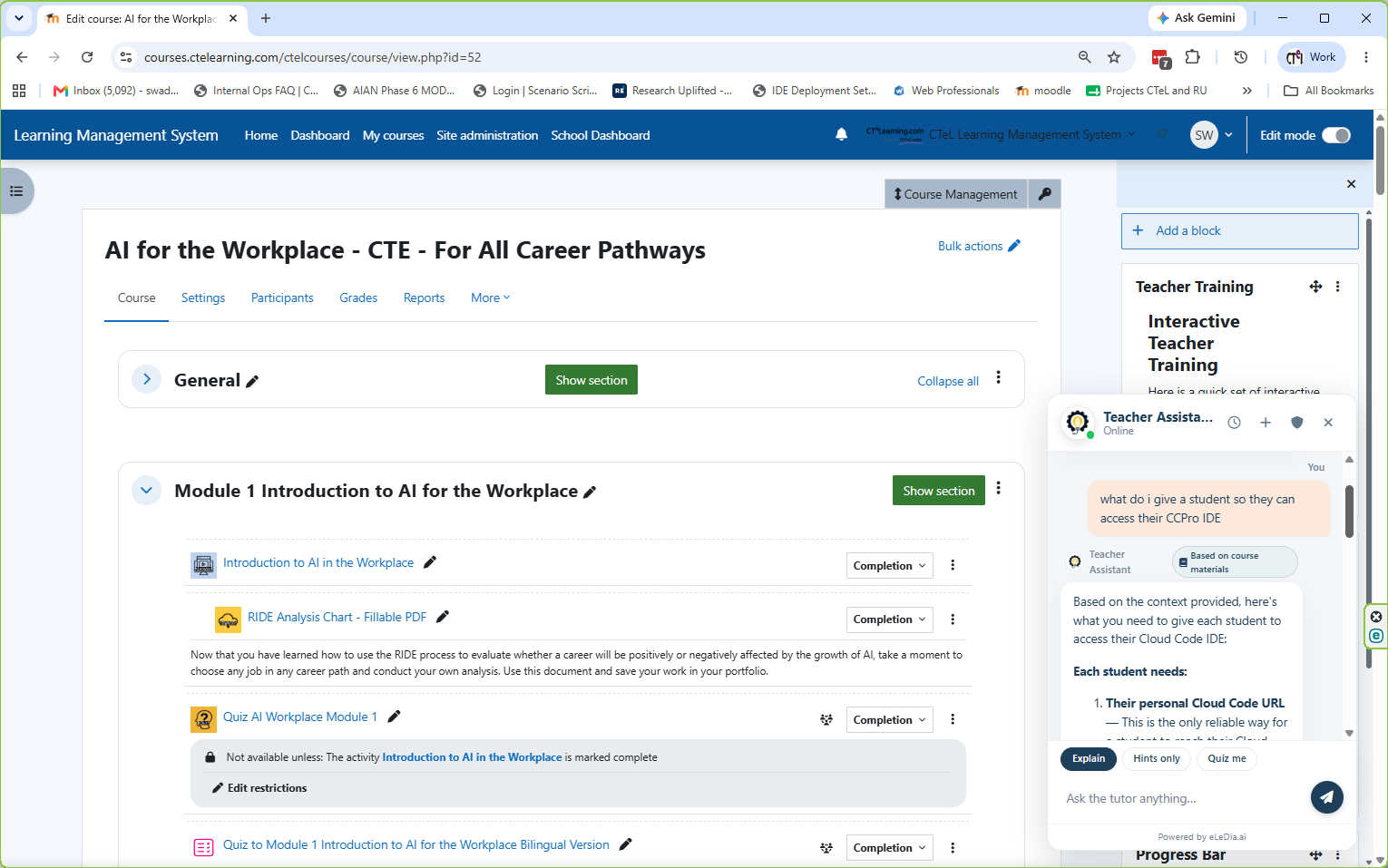
Perkins V explicitly allows for the use of funds to support professional development for CTE educators. In 2026, the rapid rise of AI and low-code/no-code platforms means that even experienced teachers need upskilling. CTeLearning doesn't just provide a student login; we provide a comprehensive teacher support system. Our curriculum includes teacher training modules that ensure your staff is as "industry-current" as the software they are teaching. This satisfies the Perkins mandate for high-quality, sustained professional development. An empowered teacher is the best defense against program stagnation and is a key factor in student retention within the pathway.


Leveraging the "Device Neutral" Advantage for Funding

In the 2026 budget environment, capital expenditures are under a microscope. Traditional CTE programs often require expensive, high-end workstations that become obsolete within three years. This creates a "funding cliff" that many districts cannot sustain. By choosing CTeLearning’sbrowser-based curriculum, districts can reallocate their Perkins hardware budget toward student certification fees or expanded program offerings.


This "Hardware Equity" is a powerful narrative for your CLNA. It proves that you are maximizing federal dollars by choosing sustainable technology that works on existing district Chromebooks. You are no longer asking for money for "computers"; you are asking for money for "careers." This shift in language is vital when presenting your local application to school boards and state agencies who are wary of recurring technology costs.


Accountability and Performance Indicators

Perkins V identifies several Core Indicators of Performance that every director must track. These include graduation rates, academic proficiency, and postsecondary placement. However, the most challenging indicator for many is the Attainment of Postsecondary Credits or Credentials.


In the 2026 landscape, state education agencies are increasingly skeptical of "locally developed" certificates. They want to see credentials that have "portability"—meaning they are recognized across state lines and by private industry. CTeLearning’s pathways are designed specifically to satisfy this portability requirement. By the time a student reaches their "concentrator" status (the second or third course in a sequence), they are already prepared for exams that carry national weight. This simplifies your reporting and ensures your program remains in the "green" on state accountability dashboards.


Collaborative Partnerships: Industry and Education

Finally, Perkins V emphasizes the importance of partnerships. Your program must prove that it has an active advisory committee. CTeLearning essentially acts as your "extended advisory board." We provide the industry research, the updated JTAs, and the professional networking that many smaller districts struggle to coordinate on their own. We help you tell the story of your program's relevance to the 21st-century economy.

We also assist in navigating the nuances of the "Reserve Fund"—a portion of Perkins funding that states can set aside for innovative programs in rural areas or areas with high concentrations of CTE students. Because our curriculum is easily deployable in any environment, it is an ideal candidate for these specialized grant applications.


Conclusion: Securing Your Program’s Future

Navigating the complexities of Perkins V doesn't have to be a solo journey. CTeLearning is dedicated to providing the standards-aligned, industry-validated, and device-neutral curriculum you need to keep your program compliant and your students successful. By focusing on IRCs of value, data-driven accountability, and industry-backed JTAs, you are not just checking a box for an auditor—you are building a future-proof pipeline for your community.


Success in 2026 requires a shift from "teaching a subject" to "building a career pathway." With the right curriculum partner, your district can transform its CTE offerings into a flagship of modern education that stands up to federal scrutiny and, more importantly, changes student lives.


Contact our team today to schedule a consultation on aligning your digital media pathways for 2026 and beyond.


Share To

Get in touch with us today!


You can book a demo directly using Calendly, call us directly at 913-764-4272 or 877-828-1216, or submit the form and we will reach out to you.


We look forward to helping you and your students.

students with STEM certifications

Most Recent Posts

By Steve Waddell February 3, 2026
Avoid expensive hardware refreshes. Move your animation lab to a 100% web-based curriculum that runs on any device and includes free industry certifications.
student using web design curriculum
By Steve Waddell January 22, 2026
Solving the biggest challenges in teaching web design. Learn how CTeLearning’s turnkey curriculum overcomes the expertise gap, budget cuts, and IT hurdles.
Chromebooks for career exploration in a cte classroom
By Steve Waddell January 2, 2026
Discover how 2026 CTE high school and middle school pathways are bridging the skills gap and why industry-aligned curriculum are essential for student success.