Blog

How One California School is Delivering Animation Certificates for Students

Joshua Frisch • May 27, 2022

We had the chance to catch up for a quick interview with Nikki Jarvis from Lakeview Leadership Academy about the animation certificates she is delivering for her students. Lakeview Leadership Academy serves grades 7-12 and draws students from the richly ethnically diverse population in the ruggedly beautiful high desert of San Bernardino County, CA.


Nikki has been teaching CTeLearning’s Animation curriculum since 2014. She has grown her program from just a few students into a very popular career-oriented graphic design and animation program that truly reflects her personality and passion for teaching.


Nikki is one of the first teachers to deploy the new industry-relevant certificate model that CTeLearning and the Web Professionals Organization have partnered together to create. This model embeds certificates directly into the curriculum, removing test anxiety for students. The model is streamlining how industry certificates are earned in secondary, post-secondary, and workforce education. Nikki was proud to award animation certificates to a number of her students this spring.

Steve Waddell, founder and lead developer of CTeLearning, had the pleasure of catching up with Nikki during her planning period to chat about her recent work and the impact it has had on her students.

How do you explain this opportunity to your students? 

Right from the start of the semester, we watch some of the videos in the course featuring professionals who work in animation. They talk about what it is like getting started, and I tell my students that this is their first day in the animation industry. I let them know that they will have the chance to earn the Web Animator international industry-recognized certificate from the Web Professionals Organization. We talk about how this is a post-secondary-level certificate. I explain that as part of this class they will take part in a Virtual Internship or career simulation so they better understand what it means to have a job, clients, and bosses as well as what it is like to create world-class products. If they just want to play, they know this is not the class. I expect them to conduct themselves professionally because they are on a potential career pathway that they may one day pursue even further. And you know what? Most of my students rise to the challenge. We even have professors from California State University, Los Angeles inviting my students to come and visit them. We also have many students who are ESL and FRPM, which is one of the reasons why I have been such a big advocate for equal opportunities for them to earn animation certificates.

How have your students been enjoying the curriculum?

They’re really getting to learn more than just animating—this is a complete career experience. I mean with the Virtual Internship projects, this class runs like a career simulator. We are doing something relevant for the students’ futures. My students learn just how broad the animation career pathway is. I talk to them about career next steps, colleges and future career options, and how they can use their animation certificates as certified web animators to develop that career pathway.

How have parents responded to it?

When I tell parents about the projects, portfolio, industry approach and credentials, they really understand it because they want their kids prepared for the real-world. Parents understand their kids are getting to learn industry-level skills in the classroom.

Can you talk about how important it is not to teach to the test?

I have been teaching this curriculum for several years, and this was the first year that the CTeLearning curriculum has all of the elements and requirements for the industry-based certificate embedded, which means that students earn their animation certificates as they go through the course and create real-world projects. The whole course is a model for mastery education. There is no big exam at the end, as that is not the most effective way of teaching. This rewards my students for all their work—not just passing a test. Every teacher knows that most students struggle with test anxiety—I do too. This year, my students focused solely on the curriculum. This allowed me to completely focus on helping the students master their learning and project work without worrying about another high-stakes test that could rattle them. I was able to tell them that their path to earning the certificate came not from some big scary test at the end of the class, but through their creativity, problem solving, skills, industry knowledge, project work and portfolio. And the certificates are underwritten for my students as well, so there was no testing company fee I would have had to ask my administrators to pay for.

What was it like presenting the students with their animation certificates?

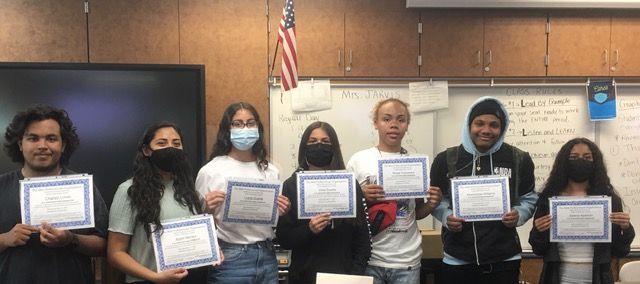
I had each group of animation certificate earners come up to the front of the class and I presented them with a nicely printed certificate in a clear plastic holder. I am also a graphic design teacher, so I had to kick it up a notch. Then we took a class picture they could have to show their parents. The coolest thing was at our senior awards ceremony, when I got the chance to give my seniors their certificates in front of everyone including their friends and family. These are the moments that educators live for. One look in the eyes of my seniors, and I could see all the pride they had. I gave them a moment they will not forget—plus the education, experience, and confidence that comes with my animation classes.

7th Period – From left to right: Charles Lucas, Adalit Montes (MDCP CTE Student of the Year), Lyana Duarte, Velia Duarte, Royal Chambers, Knowledge Williams, Selena Aparicio

The newly minted 2022 Certified Web Animators are: Bahari H., Alejandro L., Angelo M., Naveyra S., Joel H., Breana B., Zoey D., Robert G., Omar M., Jocelyn M., Sophia M., Guy D. R., Zenaida R., Ivy T., Selena A., Royal C., Velia D., Charles L., Capri E. B., Carjon R., Lyana D., Adalit M., and Knowledge W.

What else did your students accomplish? 

In addition to the Web Animator certificates, the Ethics in the Workplace micro-credential was embedded in the course. As my students earned the Ethics micro-credential, they became even more motivated to work hard for the “big” Web Animator certificate. This year we had more certificate recipients than ever before. In fact, we had four times as many as any previous year, so this new approach works extremely well.

How have you enjoyed working with CTeLearning?

I love it. Whenever I ask a question, the CTeLearning team is crazy quick to respond. Everyone is great to work with, and they listen to me. I have seen how my suggestions have been taken to heart and they have improved the curriculum to continue to make it better for students as well as teachers.

Who would you like to thank for helping to make this happen for your students?

First, let me say I have a fantastic admin team here. I know teachers in other districts who may struggle with implementing industry-based certificates for their students, but that is not the case here at Lakeview. A huge thanks to Lorraine Collins (district-level Director of CTE and Adult Education), Kellie Williams (district-level CTE Coordinator), Felicia Limbrick (Principal), and Sherri Osterberg (Department Chair), who have all been so supportive to me and the students throughout this process. And thanks again to CTeLearning and the Web Professionals Organization for underwriting the cost of all the student certificates. We appreciate the members of the Web Professionals organization who are so passionate about supporting the next generation of professionals. Thank you for providing us the opportunity to be able to earn these certificates and understanding how important it is to get high schoolers engaged, inspired and credentialed for a fantastic career pathway.

Steve said, “First, the interview was so much fun. Hearing the joy and pride from Nikki about the growth of her program and so much student success made my day. This is the culmination of a big project to take the requirements and domains of an industry certificate and weave them into a project-based learning experience that would not leave any learner behind. We have built a curriculum with our industry team and our partner the Web Professionals Organization to model not only real-world problem and problem solving, but to reward the learners for their skills attainment the same way that industry rewards performance. To me and my team, the success of Nikki’s classes represents years of work to get to this point in reimagining certification. I am incredibly proud and grateful to the Web Professionals Organization for trusting us and working together to make this happen. Being who we are, we are already in 2.0 mode and enhancing the experience based on all the feedback from all our pilot schools who deployed this. The number of students receiving international industry-recognized certificates and industry-based micro-credentials has gone up, on average 600%. We’ll know more when we get the final tallies in late June. But, at this point, there is no going back. We have proved the model and we have gotten the thumbs up from Mark DuBois, the Executive Director for the Web Professionals Organization. Ms. Jarvis is an awesome teacher, and I appreciate her and the Lakeview Leadership Academy administration as well as the students for letting us be a part of their work.” 

Get Your Students Engaged With CTE Curriculum and Certificates

If you are a teacher, administrator or parent who is interested in getting your students engaged in exciting animation certificates and other CTE certificates, contact us today. Call or email our founder and lead developer, Steve Waddell, directly at 913-764-4272 or swaddell@ctelearning.com.

Share To

Get in touch with us today!


You can book a demo directly using Calendly, call us directly at 913-764-4272 or 877-828-1216, or submit the form and we will reach out to you.


We look forward to helping you and your students.

students with STEM certifications

Most Recent Posts

By Steve Waddell November 14, 2025
Learn how we can help your school maximize the value of your current devices.
By Steve Waddell November 5, 2025
Here at CTeLearning, we keep up with trends in education and the workplace in order to better serve our schools. One recent trend is that the landscape of STEM education is undergoing a profound transformation. High school students who once aspired to traditional computer science careers are now exploring interdisciplinary fields that blend coding with data analysis, ethical interpretation, and creative problem-solving. This shift reflects a broader understanding: artificial intelligence isn't replacing human creativity and critical thinking—it's amplifying them. Let’s take a look at what this means. The Changing Face of STEM Education Research shows that AI is fundamentally reshaping how students approach STEM subjects. Rather than focusing solely on programming skills, today's students are learning to integrate machine learning into traditional disciplines like biology, physics, and design. They're using AI tools to model climate change, analyze genetic data, and solve real-world problems that require both computational skills and scientific inquiry. This evolution represents more than just adding new courses to the curriculum—it's about fundamentally changing how students think about innovation and problem-solving. Educators across the country report that teenagers are increasingly drawn to AI's potential, but they need guidance to understand how to use these tools effectively and ethically. The challenge isn't whether to integrate AI into education; it's how to do so in a way that enhances rather than diminishes core learning objectives. What's particularly striking about this shift is the recognition that AI skills are becoming essential across all career pathways, not just in technology fields. By 2027, 75% of businesses are anticipated to use AI technologies, and company leaders increasingly value AI capabilities in prospective employees. Perhaps most telling: 60% of companies report they would hire a less experienced candidate with basic AI skills over a more experienced individual without them. These statistics underscore a critical reality—students who understand how to work alongside AI will have a significant competitive advantage in virtually any career they choose. The Importance of Process Over Product At CTeLearning, we've always believed that understanding the process is more important than simply producing a final product. This philosophy has guided our curriculum development for over two decades, and it's never been more relevant than in the age of AI. In our Web Design course, for example, students don't just learn to code websites—they learn to think like designers and developers. They master color theory, site aesthetics, wireframing, and testing. They learn how to engage with clients, collaborate with team members, communicate effectively, and deliver projects on time and on budget. These process-oriented skills are what separate proficient web designers from those who can only follow tutorials. This emphasis on process becomes even more critical when AI tools enter the picture. AI can generate code, suggest design layouts, and automate repetitive tasks. But it cannot understand a client's brand story, navigate the nuances of user experience design, or make the creative decisions that transform a functional website into an engaging digital experience. Students who understand the design process can leverage AI to enhance their work while maintaining creative control and professional standards. Our approach to teaching web design mirrors the real-world creative process that professionals use daily. Students learn to: Research and understand requirements before jumping into design Develop concepts and style tiles that communicate visual direction Create wireframes that establish structure and user flow Build iteratively with opportunities for feedback and revision Test and refine their work based on user experience principles Present and explain their design decisions professionally When students internalize this process, they develop problem-solving frameworks that transcend specific tools or technologies. Whether they're working with HTML and CSS today, or with AI-assisted design tools tomorrow, they understand how to approach creative challenges systematically and thoughtfully. Creativity as a Core Competency Our courses are designed around a fundamental principle: creativity is not just an artistic skill—it's a professional competency that can be taught, practiced, and refined. In our Web Design curriculum, students engage in project-based learning that encourages creative expression while building technical proficiency. The creative process we emphasize involves: Experimentation and Iteration : Students learn that great design rarely happens on the first attempt. Our curriculum builds in time for experimentation, revision, and refinement. The coding sandbox feature allows students to practice new concepts immediately, encouraging them to try different approaches and learn from both successes and failures. Critical Assessment : We teach students to critically evaluate their own work and the work of others. This skill helps them understand what makes design effective, identify areas for improvement, and articulate the reasoning behind their creative decisions. Unique Voice Development : While students learn industry standards and best practices, we also encourage them to develop their own creative voice. The projects in our courses allow for personal expression within professional frameworks, helping students build portfolios that showcase both technical competence and creative vision. This focus on creativity serves students well in an AI-enhanced workplace. AI tools can suggest solutions, but they require human creativity to frame problems effectively, evaluate options critically, and make decisions that align with project goals and user needs. Students who develop strong creative thinking skills become AI users who guide technology toward meaningful outcomes, rather than passive consumers who accept whatever AI generates. AI for the Workplace Understanding the growing importance of AI literacy across all career pathways, we developed the AI for the Workplace course to equip students with practical AI skills they can apply regardless of their future educational or professional direction. This course takes a fundamentally different approach from many AI education initiatives—rather than focusing on how to build AI systems, we teach students how to work effectively with AI as a professional tool. The course is built around several core principles: AI as an Enhancement, Not a Replacement : We explicitly teach students that AI is a tool to enhance their capabilities, not replace their thinking. Just as calculators didn't eliminate the need to understand mathematics, AI tools don't eliminate the need for critical thinking, creativity, and professional judgment. Students learn to use AI to streamline work, generate ideas, and tackle complex problems more efficiently—while maintaining ownership of their decisions and outputs. Practical, Cross-Industry Application : The course features our PromptScout tool, which provides students with over 5,000 example prompts from 63 different industries and job categories. This exposure helps students understand that AI isn't just for programmers or data scientists—it's increasingly relevant for welders, dental hygienists, marketing professionals, educators, and countless other careers. By exploring AI applications across diverse fields, students can envision how these tools might support their own career interests. Ethical and Responsible Use : We emphasize that working with AI requires understanding its limitations, biases, and ethical implications. Students learn to evaluate AI outputs critically, recognize when AI might produce misleading or inappropriate results, and understand their responsibility as AI users. This includes discussions about plagiarism, intellectual property, data privacy, and the importance of transparency about AI use in professional settings. Real-World Scenarios : Rather than abstract concepts, the course presents students with authentic workplace scenarios where AI can provide value. Students practice using AI for research, content creation, problem-solving, and decision support. They learn to write effective prompts, evaluate results critically, and integrate AI insights into their work appropriately. Why AI Isn't a Threat—It's an Opportunity There's considerable anxiety in education about AI potentially replacing jobs or enabling students to bypass genuine learning. We understand these concerns, but we believe they reflect a misunderstanding of how AI functions and how education should respond. AI excels at pattern recognition, data processing, and generating content based on existing information. But it lacks several distinctly human capabilities that remain essential in virtually every professional field: Contextual Understanding : AI can't fully grasp the nuanced context of specific situations, client relationships, or organizational cultures. It doesn't understand the unspoken requirements, the historical background, or the dynamics that often shape professional decisions. Creative Vision : While AI can generate variations on existing ideas, true creative innovation—the ability to envision something fundamentally new—remains a human strength. AI can support the creative process, but it can't originate creative vision.  Ethical Judgment : AI can identify options but can't make value-based decisions about what should be done in complex situations. Professional ethics, moral reasoning, and nuanced judgment remain human responsibilities. Relationship Building : Professional success often depends on trust, communication, and interpersonal skills that no AI can replicate. Understanding clients, collaborating with colleagues, and navigating organizational dynamics require emotional intelligence and social skills. Adaptive Problem-Solving : When faced with novel situations that don't match existing patterns, humans excel at adaptive thinking—drawing on diverse experiences, making creative connections, and inventing new approaches. Students who develop these human capabilities while learning to leverage AI as a tool will be exceptionally well-prepared for the future workplace. They'll be able to accomplish more, faster, and with higher quality than those who rely on human capability alone—or those who try to rely on AI without strong foundational skills. The CTeLearning Difference: Preparing Whole Professionals Our curriculum philosophy has always focused on preparing "whole professionals"—students who possess not just technical skills, but also the soft skills, ethical understanding, and professional mindset needed for career success. This holistic approach becomes even more valuable in an AI-enhanced workplace. In our courses, students learn: Technical proficiency in their chosen field, whether web design, animation, or game development Creative problem-solving through project-based learning and iterative design processes Professional communication through client engagement scenarios and collaborative projects Ethical reasoning regarding intellectual property, copyright, workplace ethics, and now AI use Self-directed learning skills that enable them to adapt as technologies evolve Critical thinking to evaluate their work, assess options, and make informed decisions When students complete our courses and earn industry-recognized certifications, they carry with them not just technical knowledge but a professional identity. They understand what it means to work as a designer, developer, or animator. They can speak the language of their chosen field, understand professional standards, and navigate workplace expectations. Adding AI literacy to this foundation creates students who are uniquely prepared for the evolving workplace. They possess the technical skills employers need, the creative capabilities that AI cannot replicate, and the understanding of how to leverage AI tools to enhance their professional effectiveness. Looking Forward The integration of AI into education and the workplace will continue to accelerate. Rather than viewing this as a threat, we see it as an opportunity to emphasize what makes us distinctly human—our creativity, our ethical judgment, our ability to understand context, and our capacity for innovative thinking. At CTeLearning, we're committed to helping teachers prepare students for this future. Our courses provide the technical foundation, creative development, and now the AI literacy that students need to thrive. We believe in empowering students to understand and direct technology, not be directed by it. For teachers considering how to address AI in their classrooms, we encourage you to focus on these principles: Teach process alongside product : Help students understand how professionals think and work, not just what they produce Emphasize creativity and critical thinking : These human capabilities become more valuable, not less, in an AI-enhanced world Introduce AI as a tool : Frame AI as something students can learn to use effectively, not something to fear or rely upon uncritically Maintain high standards : AI shouldn't lower expectations; it should enable students to achieve more sophisticated results Address ethics explicitly : Help students understand their responsibilities as AI users in educational and professional contexts The future belongs to students who can blend human creativity with technological capability—who understand both the power and the limitations of AI, and who can apply professional judgment to decide when and how to leverage these tools. That's the kind of preparation CTeLearning provides, and it's what your students deserve. If you're interested in learning more about our Web Design course, AI for the Workplace course, or any of our other career and technical education offerings, schedule a free 20-minute demo with us. Let us show you how we can help you prepare your students for successful futures in an AI-enhanced world.
By Steve Waddell November 3, 2025
Landscape design and horticulture still offer bright future pathways for your students.